
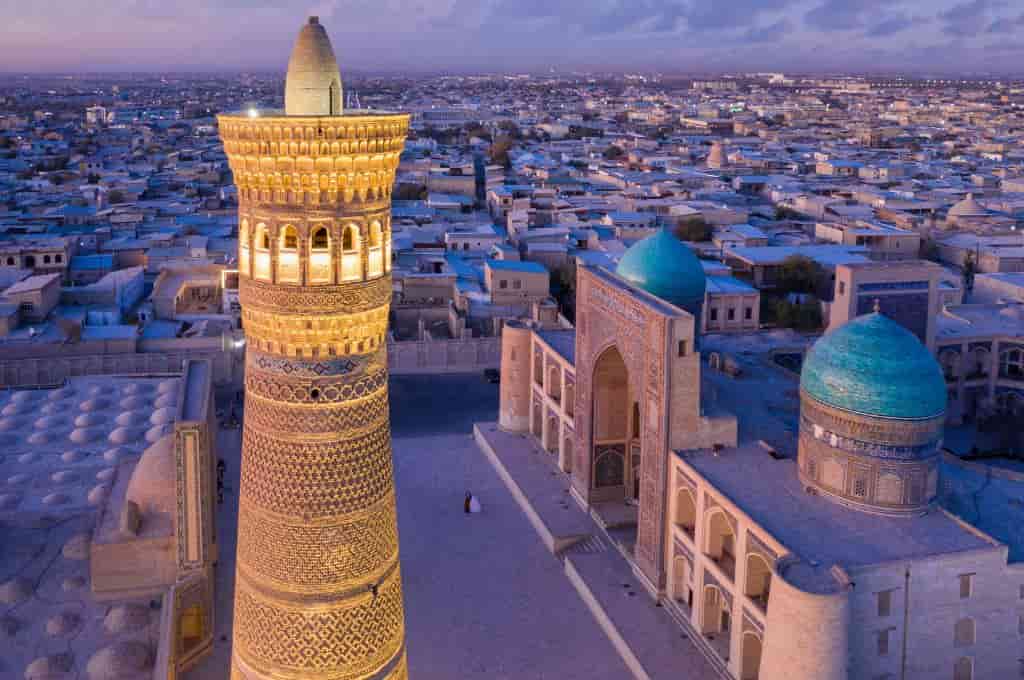
Uzbekistan is a destination where history unfolds around every turn. Sitting quietly in Central Asia, Uzbekistan has insanely stunning architecture, a fascinating history, and a cultural heritage unlike almost anywhere else. Once at the heart of the ancient Silk Road, the country is home to magnificent mosques, grand madrasas, turquoise-tiled mausoleums, packed bazaars, and beautifully restored old towns that look like they sprang right out of a fairy tale. You will find yourself wandering through ancient cities, staring at some of the most incredible Islamic architecture, collecting far more souvenirs than you intended, relishing local cuisine, and making new friends wherever you go.
A seven-day trip is short, but it’s enough to visit the country’s four must-see places — Tashkent, Samarkand, Bukhara, and Khiva — if you plan your itinerary well. Each destination has its own distinct identity: Tashkent, the capital, showcases modern Uzbekistan; Samarkand highlights the grandeur of the Timurid era; atmospheric Bukhara feels like a living Silk Road museum; and Khiva’s walled old town takes you back to an ancient world of narrow lanes, mud-brick walls, and intricate tilework.
Brief History of Uzbekistan
Uzbekistan has a unique history shaped by the rise and fall of mighty empires and by its strategic location along the Silk Road, a centuries-old trade route connecting China, Central Asia, the Middle East, and Europe. Ancient civilizations had long inhabited the region before Islam arrived. Several Persian, Turkish, and Central Asian kingdoms governed the region. From the 7th century, Islam gradually became the dominant religion. In the 13th century, Genghis Khan and the Mongols took control. A century later, Amir Timur (Tamerlane) founded a formidable empire, with Samarkand as its capital. Under Timur and his successors, the city flourished as a center of architecture, science, art, and education. Many of Samarkand’s magnificent monuments date from this era.
In the nineteenth century, the Russian Empire gradually acquired Central Asia, including the territory now known as Uzbekistan. The Soviet period brought industrialization and significant improvements to society and agriculture, but it also brought political repression. After the Soviet Union dissolved, Uzbekistan declared independence on August 31, 1991, and became an independent republic.
Places Covered in this Uzbekistan Itinerary
1. Tashkent – The Modern Gateway
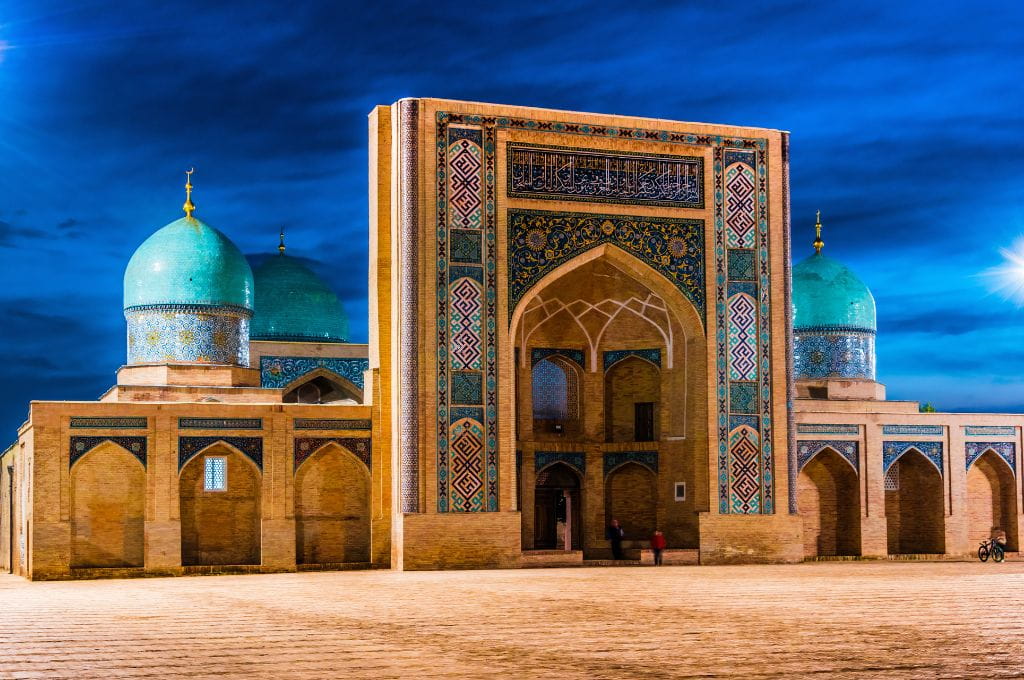
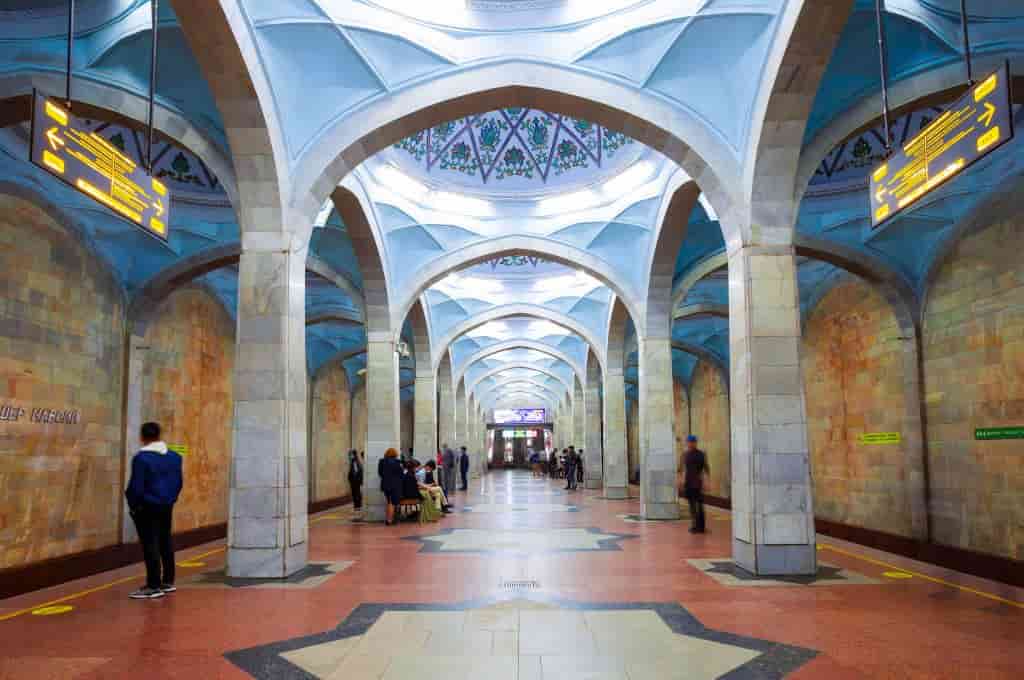
Tashkent, Uzbekistan’s dynamic capital and largest city, blends old and new. Unlike the country’s ancient Silk Road cities, Tashkent has a distinctly modern vibe, with wide boulevards, sparkling skyscrapers, and beautiful metro stations that are tourist attractions in their own right. Traces of its history remain at the Hazrat Imam Complex and Chorsu Bazaar. The kaleidoscopic market is especially worth visiting, offering a glimpse into everyday Uzbek life through stalls brimming with everything you could possibly need. Tashkent is a major entry point to Uzbekistan and offers an excellent introduction to the country’s culture and history.
Top Attractions in Tashkent
- Hazrat Imam Complex (Khast Imam) – Tashkent’s spiritual core, home to mosques, madrasas, and a 7th-century Quran manuscript.
- Chorsu Bazaar – The sprawling traditional market under a turquoise dome is renowned for its spices, dried fruits, fresh produce, local handicrafts, and the famous Uzbek bread straight from the ovens.
- Tashkent Metro Stations (Kosmonavtlar, Alisher Navoi, Paxtakor) – The extravagantly adorned metro stations resemble underground art galleries, with chandeliers and intricate mosaic marblework, and each station has its own unique aesthetic.
- Amir Timur Square – A victory square featuring an imposing equestrian statue of the legendary Central Asian ruler.
- Minor Mosque – A gleaming white-marble mosque on the banks of the Ankhor Canal.
- Independence Square – A grand public space that is the symbolic heart of modern Uzbekistan.
- Tashkent TV Tower – Offers panoramic views of the city, with a skyline that blends Soviet and modern styles.
2. Khiva – The Enchanted Walled City
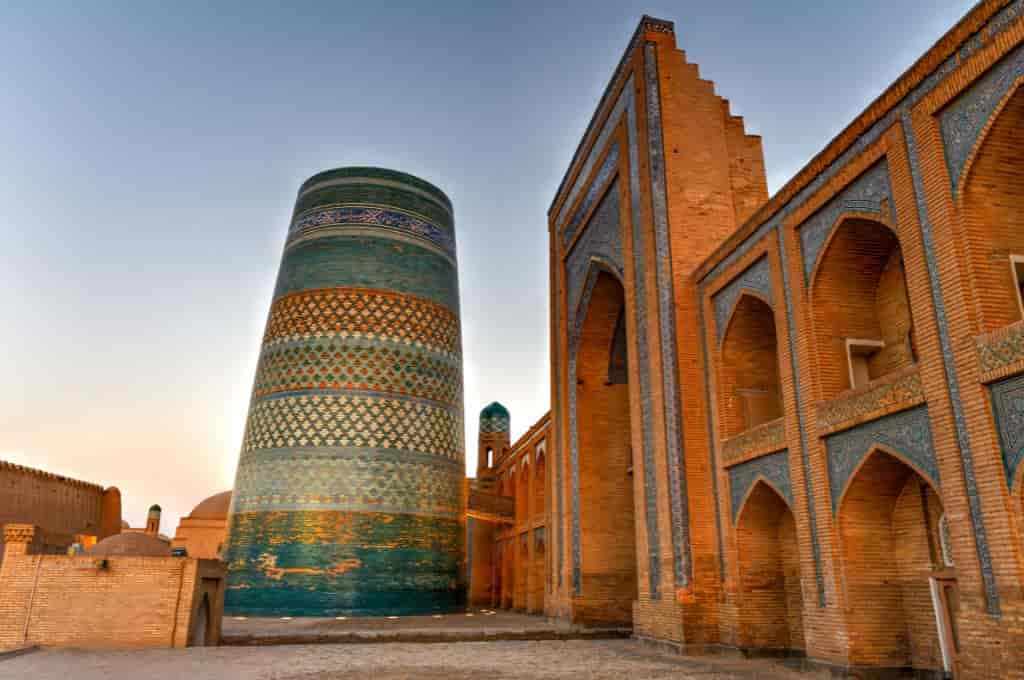
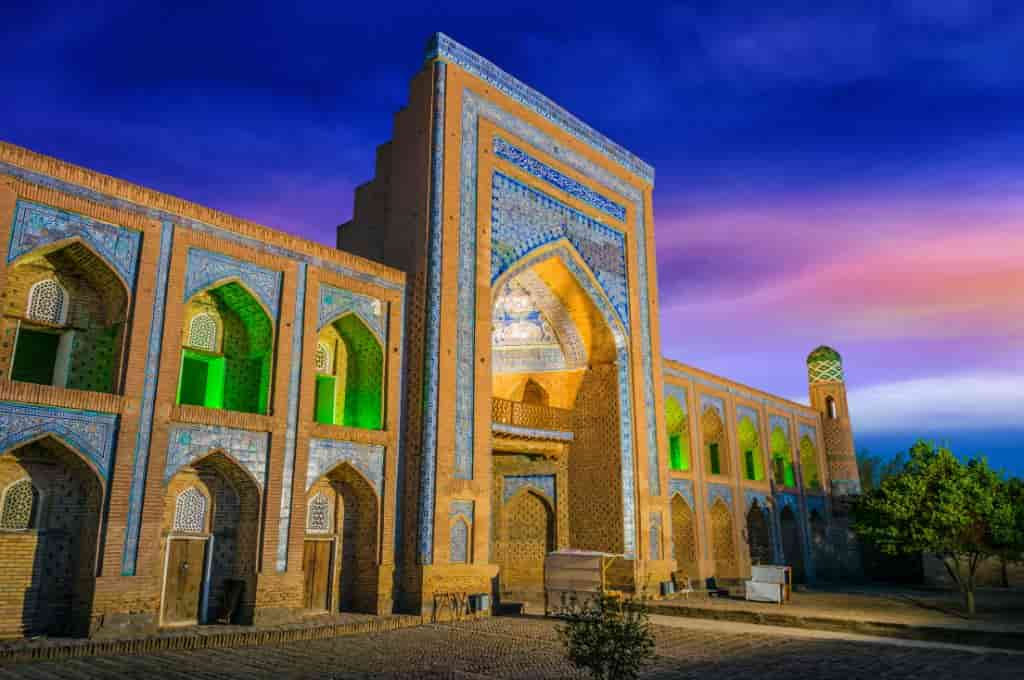
Khiva is one of Uzbekistan’s most charming historic cities—and my personal favorite. At its heart lies Itchan Kala, a beautifully preserved walled inner city that has remained largely untouched for centuries. This UNESCO World Heritage site is enclosed by symmetrical city walls, with most attractions inside. Wandering its narrow lanes, lined with ochre-colored walls and vivid blue tilework, feels like stepping into a medieval Silk Road storybook. Among the city’s most prominent architectural landmarks are the unfinished Kalta Minor Minaret, Juma Mosque, Islam Khoja Minaret, and Tash Hauli Palace. Khiva looks especially magical in the early morning and around sunset, when warm light softens its ancient walls and domes. It is the hardest city to reach on this list, which is why many people skip it. But Khiva offers an unparalleled glimpse into Central Asia’s past and should definitely be on your itinerary.
- Itchan Kaala – The ancient walled inner city, dotted with mosques, madrasas, palaces, and minarets. Compact, walkable, and surreal in the golden light.
- Kalta Minor Minaret – Khiva’s instantly recognizable turquoise-tiled stump minaret, famously left unfinished.
- Kuhna Ark – The historic fortress and former residence of Khiva’s rulers, offering excellent views over the old city. Climb to the top at sunset, when the mud-brick rooftops glow orange and red.
- Juma Mosque – A unique mosque famous for its forest of individually hand-carved wooden columns (218) made from black Elm, walnut, and chinar, some dating back to the 10th century. It is unlike any other mosque you will see.
- Tash Hauli Palace – An ornate 19th-century labyrinthine residence of former Khans featuring courtyards, carved wood, and intricate blue tilework.
- Pahlavon Mahmoud Mausoleum: A sacred site imbued with Sufi spirit, intricate tilework, and vibrant turquoise domes.
- Islam Khoja Minaret – Khiva’s Minaret and one of the prime vantage points for panoramic views of Itchan Kala.
3. Bukhara – The Living Silk Road City
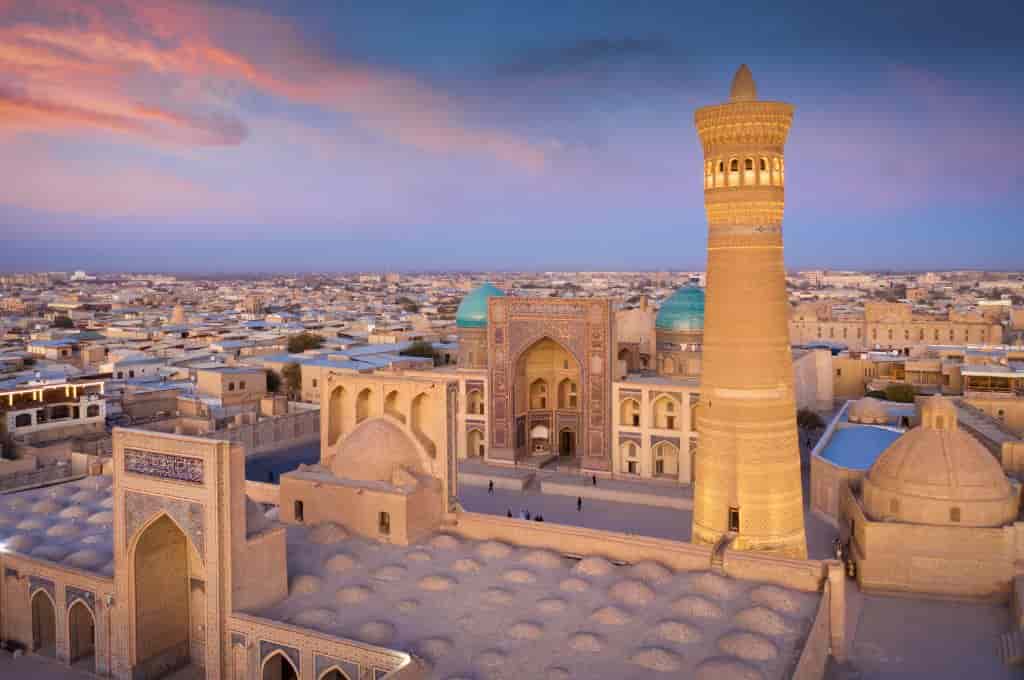
Bukhara’s Old Town feels like an open-air museum with over 140 architectural monuments. The city is more compact and mystical than Samarkand, and you can explore much of its historic core on foot. UNESCO describes it as Central Asia’s most complete medieval city. Bukhara’s history spans more than two millennia, and much of it is preserved in its old mosques, madrasas, and mausoleums. Once the Islamic world’s intellectual and spiritual capital, the ancient town was also a major commercial hub. The Po-i-Kalyan Complex is the city’s main architectural landmark, showcasing remarkable Timurid-era craftsmanship. The towering Kalyan Minaret, the historic Ark Fortress, and the tranquil Lyabi-Hauz ensemble are among the most notable sites. Bukhara also has a strong artisan culture, making it a perfect place to browse embroidered textiles, ceramics, and other local handicrafts.
- Po-i-Kalyan Complex – One of Central Asia’s most striking architectural ensembles, it features the iconic Kalyan Minaret, the adjacent Kalyan Mosque, and the still-functioning Mir-i-Arab Madrasa.
- Kalyan Minaret – The 48-meter minaret is one of Bukhara’s defining sights, rising dramatically above the old city.
- Kalyan Mosque – A majestic historic mosque with a beautiful courtyard and traditional Islamic architecture.
- Mir-i-Arab Madrasa – A striking blue-domed Islamic school overlooking the Kalyan complex.
- Ark Fortress –A massive 5th-century fortified citadel that has served as home to Bukhara’s emirs for over 1000 years.
- Lyabi-Hauz – A picturesque historic square built around a traditional pool, flanked by antique buildings, teahouses, and trees. It is still the city’s social center.
- Chor-Minor – A quirky four-towered gate that’s become a favorite among Instagrammers.
- Bolo Hauz Mosque – Known for its elegant carved wooden columns, beautifully reflected in the pool in front.
- Samanid Mausoleum – Built over 1000 years ago, this small brick cube’s pattern comes from the brickwork itself.
- Sitorai Mokhi-Khosa – Summer residence of Bukhara’s last Emir
- Ulugbek & Abdulaziz Khan Madrasas: Ulugbek Madrasa was constructed in 1417 and is the oldest preserved madrasa in Central Asia. Abdulaziz Khan Madrasa once accommodated student rooms but is now packed with souvenir shops.
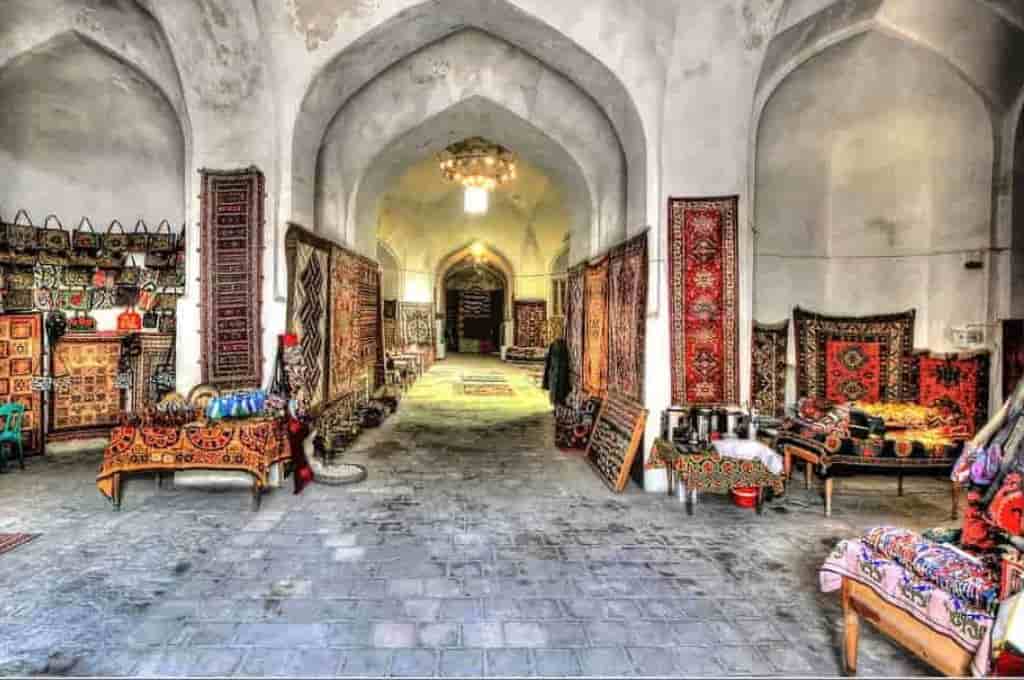
- Trading Domes (Toki Zargaron, Toki-Sarrofon, Telpak Furushon, Tim Abdullakhan) – 16th-century covered bazaars that stretch in procession, selling textiles, jewelry, ceramics, hand-woven silk carpets, suzani needlework, and handicrafts.
4. Samarkand – The Jewel of the Silk Road
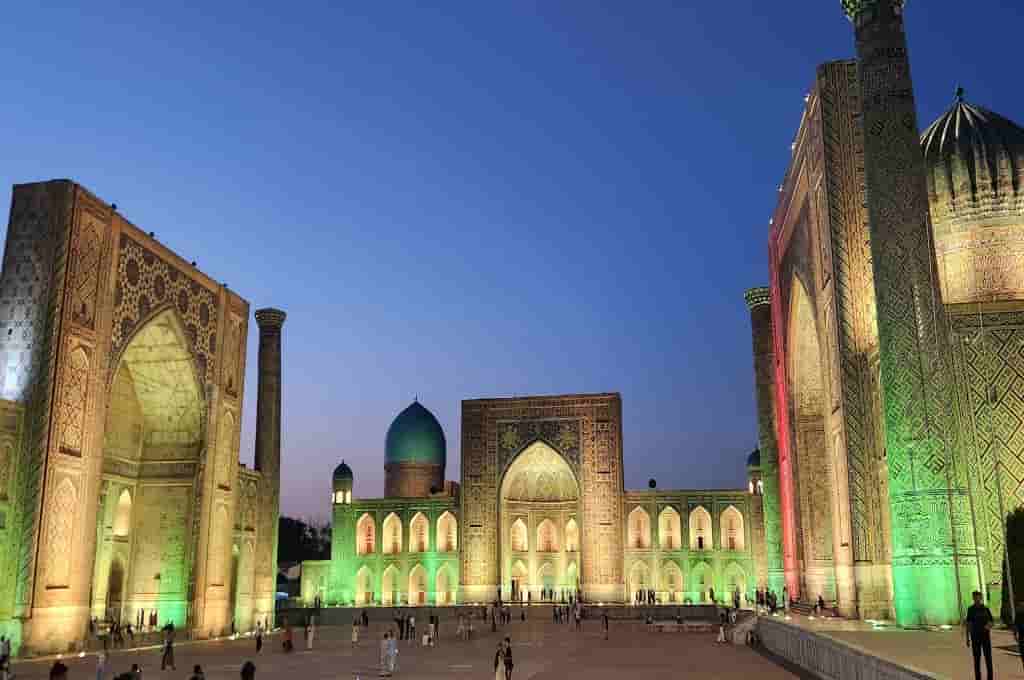
Few cities in Central Asia are as renowned as Samarkand. It is among the oldest continuously inhabited cities in Central Asia. Sometimes called the “Jewel of the Silk Road,” Samarkand reached its peak under Amir Timur in the 14th and 15th centuries, when it became the capital of his vast empire. Today, the city is celebrated for its magnificent Islamic architecture and breathtaking blue-tiled monuments. Its iconic landmark is the stunningly beautiful Registan Square, where three huge madrasas face one another in remarkable symmetry—the Timurid era’s creativity and architectural achievements shine at Shah-i-Zinda, Bibi-Khanym Mosque, and the Gur-e-Amir Mausoleum. Samarkand exudes grandeur and monumentality, making it a must-see destination on any Uzbekistan itinerary. Don’t miss the Registan Light Show—it’s amazing after dark.
Top Attractions in Samarkand
- Registan Square – The city’s defining landmark features three magnificent, blue-tiled madrasas: Ulugh Beg, Sher-Dor, and Tilya-Kori.
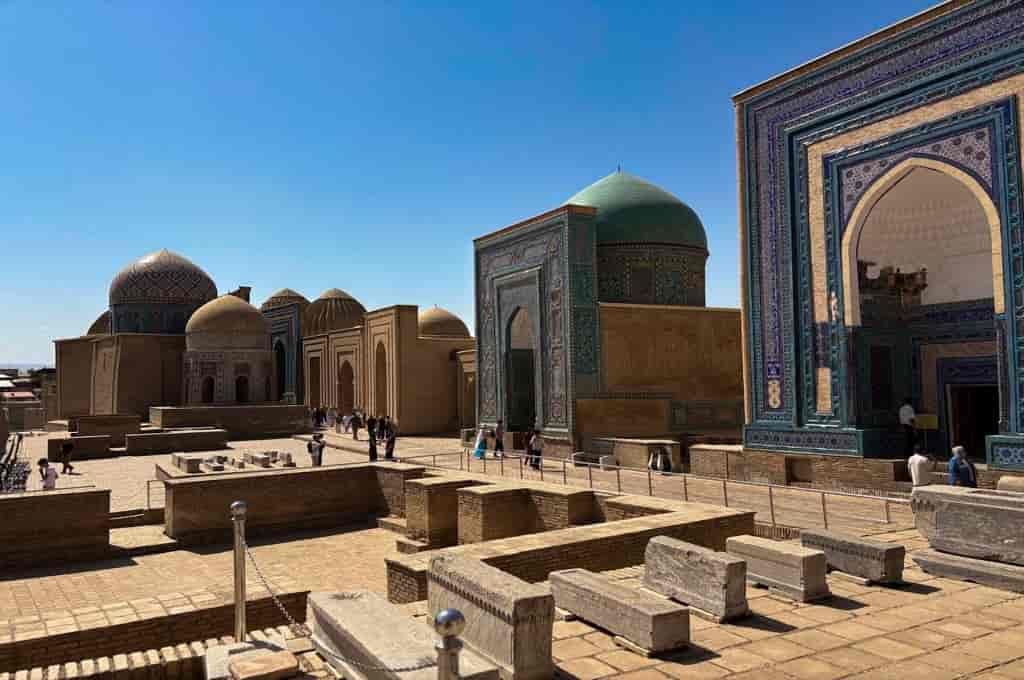
- Shah-i-Zinda – A spectacular necropolis built along a narrow hilltop lane and lined with striking turquoise-and-blue tiled mausoleums.
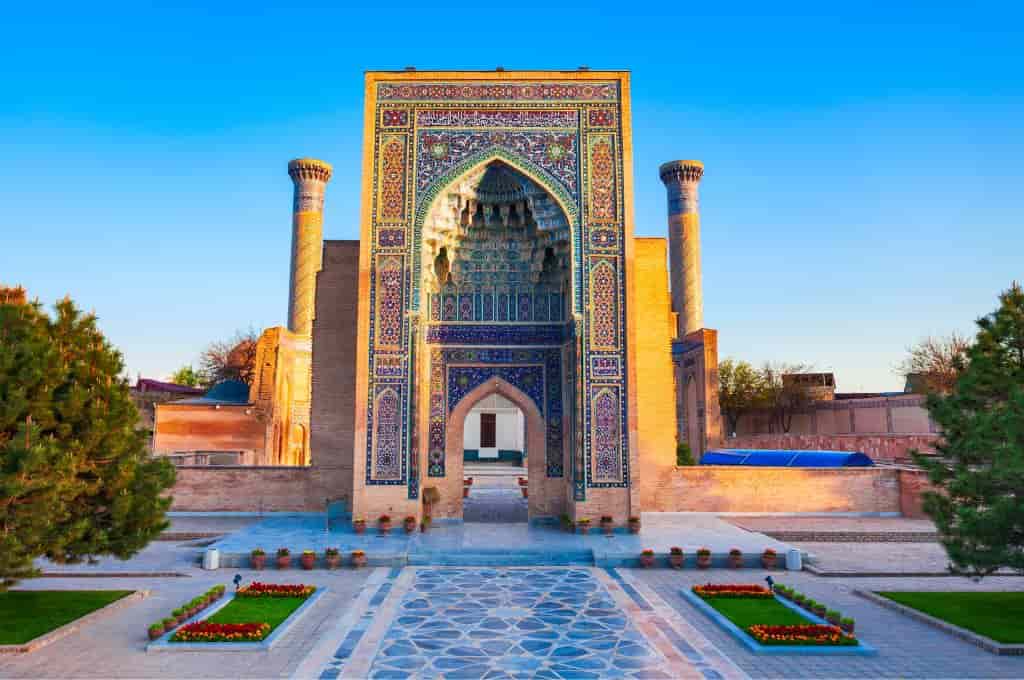
- Gur-e-Amir Mausoleum – The grand and bold tomb of Amir Timur features an impressive blue-ribbed dome and two minarets. It was inspired by the architecture of the Taj Mahal.
- Bibi-Khanym Mosque – One of Samarkand’s most imposing historic monuments, built by Timur after his Indian campaign. It was once among the largest mosques in the Islamic world.
- Siyob Bazaar – A lively traditional market offering an authentic taste of local flavors and daily life.
- Ulugh Beg Observatory – The remains of one of the finest astronomical observatories in the medieval world, built in the fifteenth century by Ulugh Beg, the grandson of Timur.
Suggested 7-day Itinerary for Uzbekistan
Day 1: Arrive in Tashkent
Start your Uzbek adventure in Tashkent, the country’s capital and primary international gateway. It will likely be your entry point, but don’t think of it only as a transit city. After checking into your hotel, spend the day exploring some of the city’s attractions. Start at Amir Timur Square, then head to Independence Square and the impressive Tashkent Metro. If you have time, go to Hazrat Imam Complex and Minor Mosque. Each metro station has unique architecture and decoration, making it worth the trip. Later, visit Chorsu Bazaar, one of the city’s most colorful markets, where locals buy and sell anything and everything.
Overnight: Tashkent
Day 2: Tashkent to Khiva
In the morning, take a domestic flight to Urgench, then hail a cab for the 40-minute ride to Khiva. After arriving in Khiva, check into your hotel and explore Itchan Kala, the ancient walled inner city. Try to book a hotel inside the walled city so you can enjoy the town in the evenings, when the streets are quieter. One of Khiva’s joys is simply wandering without a set route. Its narrow lanes, historic walls, and elaborate blue-and-green tilework make nearly every corner picturesque. As the day fades, visit one of the city’s elevated viewpoints to watch the monuments light up at blue hour. Keep wandering through the old city, stopping at small workshops and shops selling a wide range of souvenirs, apparel, and handicrafts. Khiva’s historic center is compact, so a few hours are enough for an excellent introduction to the city.
Overnight: Khiva
Day 3: Khiva to Bukhara
Today, travel to Bukhara across the golden sands of the Kyzylkum Desert. This is the longest travel day of the trip. Depending on the schedule, you can travel by road (7-8 hours) or train (6 hours) from the Khiva/Urgench area. The train runs only a few times a week, so check before you make plans. You’ll arrive in Bukhara late in the day. After checking in, spend the evening exploring the old town. Wander through the 16th-century domed trading bazaars and bargain with vendors for local products. Bukhara is a great place to shop for handicrafts and souvenirs, with convenient access and plenty of choices.
Overnight: Bukhara
Day 4: Bukhara
Walk through the imposing Po-i-Kalyan. Start at Lyabi-Hauz, then head through the narrow lanes and traditional trading domes. Visit Bukhara’s most iconic sites, including the Kalyan Minaret, Kalyan Mosque, and Mir-i-Arab Madrasa. Outside the city center, explore the Ark Fortress, Bolo Huz Mosque, and Samanid Mausoleum. There is plenty to see, so choose according to your interests. Bukhara can be especially enjoyable when explored without a set schedule.
Overnight: Bukhara
Day 5: Bukhara to Samarkand
If you still wish to explore more of Bukhara, do so in the morning before heading to your next destination. Board the high-speed train to Samarkand, a two-hour ride. Once in Samarkand, head straight to Registan Square, Central Asia’s most famous landmark. The plaza is framed by three exquisite madrasahs with intricate blue-and-turquoise tilework. The complex is breathtakingly beautiful and sure to leave you in awe.
Overnight: Samarkand
Day 6: Samarkand
Spend the day exploring Samarkand’s historic heart. Its attractions are more spread out than Bukhara’s, so plan your route carefully. Begin with the spectacular Shah-i-Zinda, a complex of mausoleums renowned for its extraordinary tilework and a photographer’s paradise. Next, visit Bibi-Khanym Mosque, Gur-e-Amir Mausoleum, and the Ulugh Beg Observatory. Stop at Siyob Bazaar for last-minute shopping, then end the day with another visit to Registan. The three gigantic madrasahs light up, creating one of the most extraordinary architectural sights.
Overnight: Samarkand
Day 7: Samarkand to Tashkent / Departure
Depending on your flight schedule, take a high-speed train (2-3 hours) from Samarkand to Tashkent for your onward international connection. If your international flight is late at night, you’ll still have time to explore more of Samarkand before taking an evening train to Tashkent. Alternatively, take a morning train and spend some time in Tashkent.
Things to know before you visit Uzbekistan
- The best times to visit Uzbekistan are spring (April-May) and autumn (September-October). During these seasons, the weather is generally warm and dry, making it comfortable to explore the country. July and August bring extreme heat, with temperatures soaring above 40 degrees Celsius in desert areas. Winters (December to February) can be very cold, especially in northern and mountainous regions.
- Most countries are eligible for an e-visa or visa-free entry. Requirements vary by passport, so check the latest rules on the Uzbekistan e-visa website before traveling.
- Uzbekistan’s official currency is the Uzbek Som (UZS), though U.S. dollars are widely accepted. The country remains largely cash-based, so always carry cash. Hotels and fine restaurants accept major credit cards, but you’ll need cash at bazaars, small cafés, and souvenir stalls. You can withdraw money from ATMs after you arrive. Tashkent Airport has an exchange counter with a good exchange rate.
- Getting around Uzbekistan is easy, especially between major cities. Most travelers combine trains, flights, and taxis depending on the distance and time. For intercity travel, the Afrosiyob Bullet Train is the best option: it’s clean, fast, comfortable, reliable, and affordable. Ideal for traveling between Tashkent, Samarkand, and Bukhara. High-speed train tickets are in high demand, so book as far in advance as possible. To get around the city, download the Yandex Go app. It works similarly to Uber and is very affordable. Tashkent also has a reasonably priced metro.
- Although Uzbekistan may seem very different from the Western world, it is an exceptionally safe destination for travelers. The locals are kind and welcoming.
- English is common in tourist areas, and English-speaking guides are easy to arrange.
- Uzbek cuisine is heavy on meat, and vegetarians might find it hard to find vegetarian options. However, if you inform restaurants in advance, they can put something together. Top dishes to try include plov (rice pilaf), Shashlik (skewers), manti (dumplings), lagman (noodle soup), and samsa (baked pastries).
- Shopping is an integral part of the sightseeing experience. Chorsu Bazar in Tashkent, Siyob Bazar in Samarkand, and Bukhara’s trade domes remain active markets where locals buy everyday essentials. Bargaining is both expected and fun. Even larger shops are open to negotiation.
- Uzbekistan is relatively conservative, so dressing modestly is appreciated and helps you blend in comfortably. When visiting active mosques or religious mausoleums, both men and women should cover their shoulders and knees. Women should also carry a light scarf for mosque visits. Public displays of affection are minimal in Uzbekistan.